

What Happens If Heat Is Applied Unevenly?
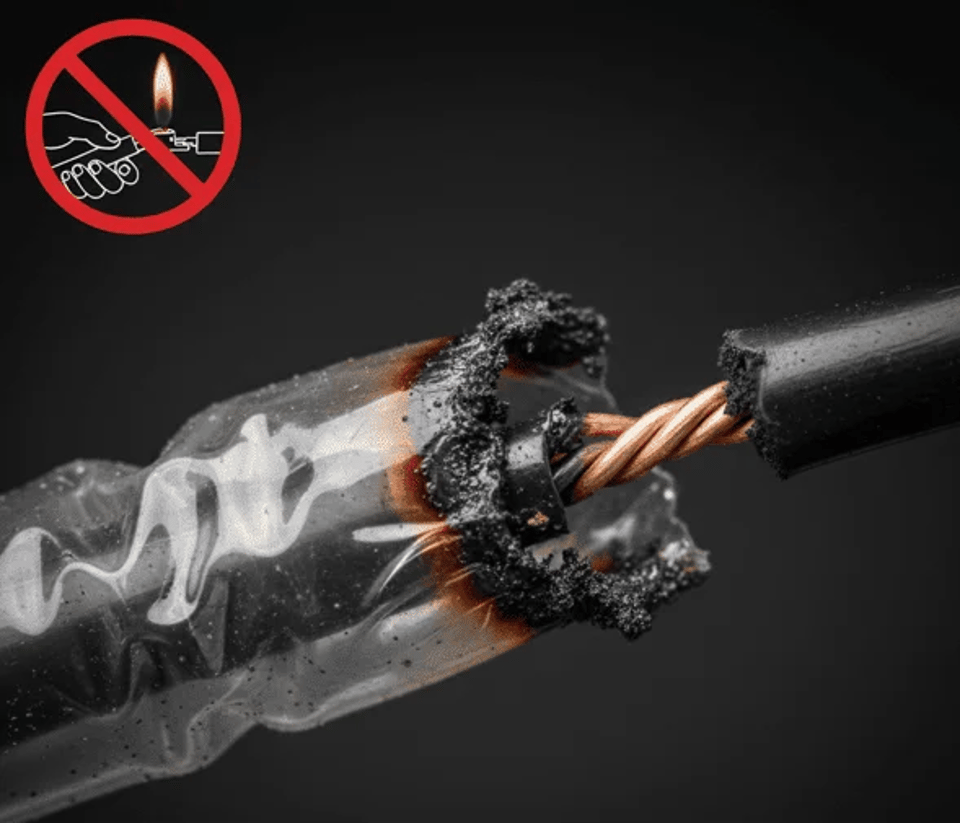
PROBLEM 1 — OVERHEATING
Too much heat causes the tubing to thin unevenly, curl at the edges, or take on that shiny, scorched look. If it smells, this is your culprit, too. Open flames and high-output heat guns create hot spots that blast one area while the rest barely shrinks. That's why one side of your heat shrink can look overcooked while the other still looks thick. Overheating happens fast when the heat source is too close or stays in one spot too long.
This happens when you hold the heat gun too close or in one spot too long. The tubing becomes glossy, then may char or melt, making it brittle.
Signs: Burn marks, charring, blistering, cracking, shiny surface, or strong odor
Risk: Compromised dielectric strength and mechanical protection — the connection is no longer reliably insulated
PROBLEM 2 — UNDERHEATING
When the tubing doesn't get enough consistent heat, it never fully conforms to the wire underneath. The walls stay thick and soft, air gets trapped inside, and the ends don't seal the way they should. You'll see uneven shrinkage, open gaps, or that slightly inflated look where the tubing tightened in some spots but not others.
Underheating heat shrink is very common when the heat source is too far away or moves past the tubing before it has time to fully contract.
Signs: Loose fit, inflated sections, gaps at the ends, or wrinkles that do not smooth out
Risk: Moisture enters through unsealed ends; corrosion creeps up the copper conductor over time
PROBLEM 3 — AIR BUBBLES
Many people start shrinking from one end and go to the other. This pushes air toward the far end, where it gets trapped, forming a large bubble that cannot escape. When the length of the heat shrinkable tube is too long (more than 50 cm), it cannot be heated at will. It should be unilaterally heated and moved uniformly from one end to the other, shrinking slowly so that all the air inside is gradually evacuated, or heating from the middle to both sides.
Inadequate heat distribution during the shrinking process can cause some areas of the wrap to shrink faster than others, resulting in air pockets.
Signs: Raised pocket under tubing, uneven profile, loose section in the middle
Fix: Always start heating from the center and work outward — this forces all trapped air out toward both ends
PROBLEM 4 — USING OPEN FLAME INSTEAD OF HEAT GUN
The flame is far too hot for most tubing materials, causing them to burn and become brittle rather than shrinking uniformly. This compromises the tubing's dielectric strength and mechanical protection. You can instantly see the difference between a shrink from a heat gun versus a lighter; the lighter-shrunk tube is often shiny in some spots, burnt in others, and covered in soot.
Open flames deposit carbon soot (conductive!), cause uneven shrinkage, and degrade the polymer chains, making the tube brittle. The intense, pinpoint heat from a flame can melt the primary insulation on the wire, creating a short circuit risk.
CORRECT TECHNIQUE AT A GLANCE
| ✔ Start from the center, work outward |
| ✔ Keep the heat gun moving at 2–3 inches distance |
| ✔ Rotate the cable while heating |
| ✔ Watch for color and gloss changes |
| ✗ Never use a lighter or open torch |